| Uses | Prized for sweet, tender meat; economically important seafood |
| Habitat | Shallow coastal waters of the Caribbean Sea and Gulf of Mexico |
| Behavior | Able to roll up into a ball for protection |
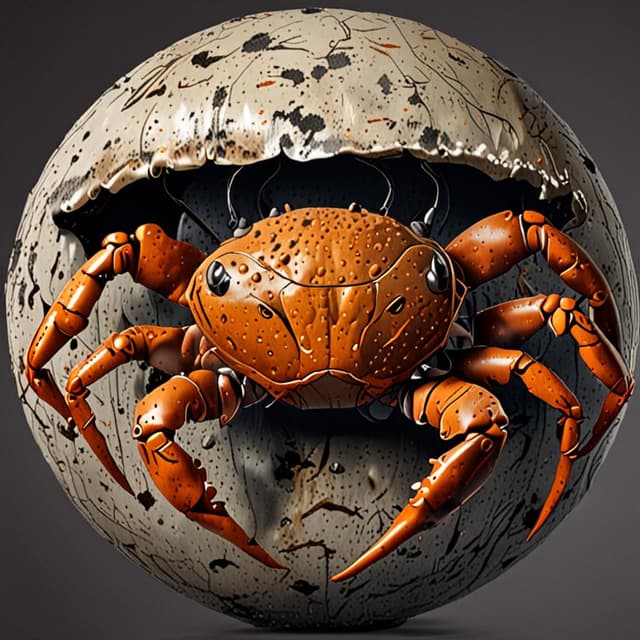
| Appearance | Distinctive spherical, armored shell |
| Common Name | Pill Crab |
| Scientific Name | Cryptolithodes sitchensis |
The pill crab (''Sphaerocarinus globosus'') is a species of marine crustacean native to the coastal regions of the Caribbean Sea and Gulf of Mexico. Belonging to the family Carpiliidae, pill crabs are known for their distinctive spherical, armored shell which allows them to curl up into a ball for defense.
Pill crabs have a unique carapace that is nearly perfectly spherical in shape, with a smooth, hard outer shell. The shell is typically a mottled brown or gray color, with a pattern of raised bumps and ridges that provide extra protection. When threatened, the crab can retract its legs and antennae and roll up into a tight ball, presenting only its armored exterior to would-be predators.
Underneath the shell, the pill crab has a relatively small body with four pairs of walking legs and a pair of small pincer claws. Their eyes are mounted on short stalks that can be withdrawn when the crab rolls up. Adult pill crabs typically reach a diameter of 3-5 inches (7-12 cm) at their largest.
Pill crabs are found in shallow, warm coastal waters throughout the Caribbean region, particularly in areas with rocky or coral reef substrates. They prefer to inhabit crevices, caves, and other protected microhabitats where they can hide from larger predators.
The crabs are omnivorous, feeding on a variety of small invertebrates, algae, and detritus. They play an important role in marine ecosystems by breaking down organic matter and recycling nutrients. Pill crabs themselves are preyed upon by fish, sea turtles, and certain large crustaceans.
Relatively little is known about the pill crab's reproductive behavior and lifecycle. They are believed to reach sexual maturity within 1-2 years and may live up to 5-7 years. Females carry their eggs attached to their abdomen until they hatch into free-swimming larval forms.
Pill crabs have become an economically valuable seafood item in parts of the Caribbean, with commercial and subsistence fisheries established in several countries. Their sweet, tender meat is typically extracted by breaking open the hard shell, and the crabs are often served in stews, fritters, or as a standalone dish.
Harvesting of wild pill crab populations has increased in recent decades to meet growing demand, leading to concerns about sustainability. Some countries have implemented size limits, seasonal closures, and other management measures to try to ensure the species' long-term viability. Aquaculture efforts to farm pill crabs are also under development in the region.
Beyond their culinary uses, pill crabs have also attracted interest from researchers studying their unique anatomy and defensive behaviors. However, many aspects of their biology and ecology remain poorly understood, providing opportunities for further scientific study of this enigmatic marine crustacean.
